


Sieving ultra-fine powders below 45 microns (325−500 mesh) presents severe operational bottlenecks in advanced manufacturing. Issues such as static accumulation, moisture tension, and particle agglomeration frequently lead to mesh blinding—where fine particles wedge into the mesh openings, rapidly reducing throughput and stopping production.
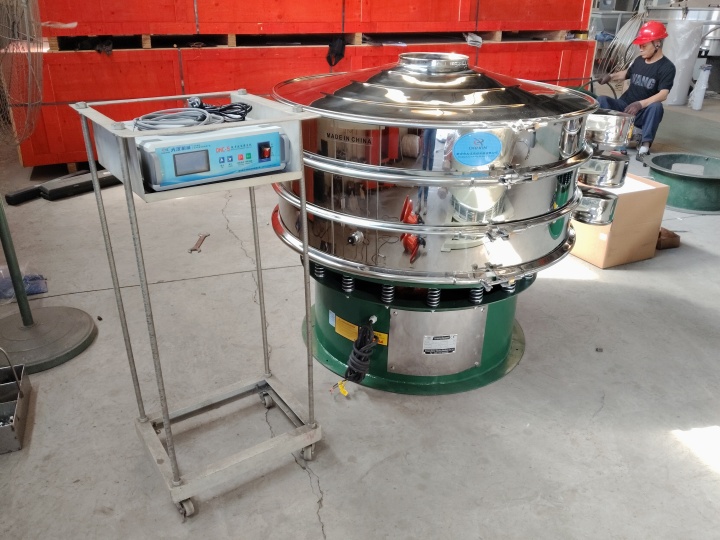
Traditional mechanical clearing methods (such as bounce balls or rotating brushes) often fall short with fine powders and risk introducing secondary contamination. The Ultrasonic De-blinding System offers a non-contact, continuous solution designed specifically for precision screening.
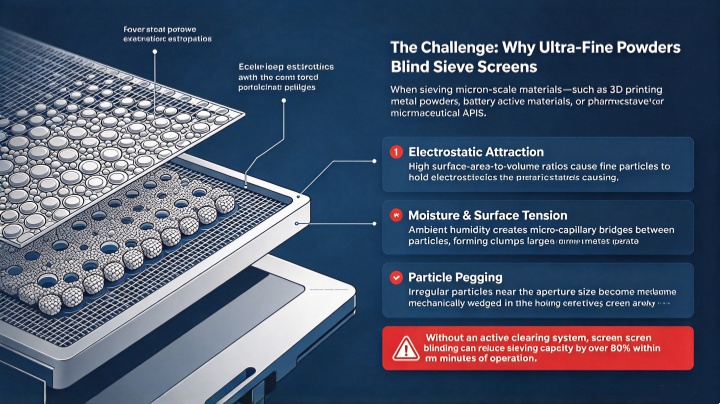
When sieving micron-scale materials—such as 3D printing metal powders, battery active materials, or pharmaceutical APIs—conventional gravity and low-frequency motion are insufficient to overcome microscopic forces:
Electrostatic Attraction: High surface-area-to-volume ratios cause fine particles to hold electrostatic charges, causing them to cling to screen wires and agglomerate.
Moisture & Surface Tension: Ambient humidity creates micro-capillary bridges between particles, forming clumps larger than the actual mesh aperture.
Particle Pegging: Irregular particles near the aperture size become mechanically wedged in the mesh, progressively choking effective screen area.
Without an active clearing system, screen blinding can reduce sieving capacity by over 80% within minutes of operation.
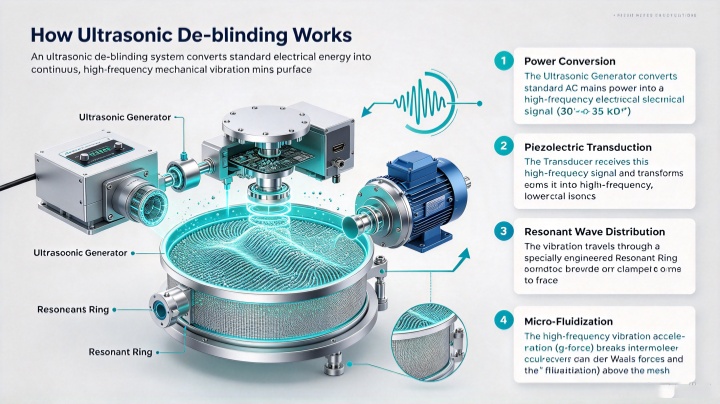
An ultrasonic de-blinding system converts standard electrical energy into continuous, high-frequency mechanical vibration applied directly to the screening surface.
Power Conversion: The Ultrasonic Generator converts standard AC mains power into a high-frequency electrical signal (30−35 kHz).
Piezoelectric Transduction: The Transducer receives this high-frequency signal and transforms it into high-frequency, low-amplitude mechanical vibrations.
Resonant Wave Distribution: The vibration travels through a specially engineered Resonant Ring bonded or clamped to the mesh frame, distributing uniform energy across the entire screen surface.
Micro-Fluidization: The high-frequency vibration acceleration (g-force) breaks intermolecular van der Waals forces and static bonds, keeping fine particles in a state of micro-suspension ("fluidization") directly above the mesh.
| Feature / Metric | Traditional Bounce Balls | Rotating Brushes | Ultrasonic De-blinding System |
| Target Mesh Size | < 100 Mesh (> 150 μm) | 100 – 200 Mesh | 200 – 635 Mesh (< 25 μm – 75 μm) |
| Contamination Risk | High (Rubber/Silicone wear) | High (Bristle shear & wear) | Zero (Pure high-frequency wave) |
| Screen Wear | High (Repetitive mechanical impact) | Moderate–High (Frictional abrasion) | Minimal (Extends mesh service life) |
| Sieving Throughput | Baseline (1×) | 1.2× – 1.5× | 3× – 10× Increase |
| Gas Tightness / Inert Suitability | Limited | Poor | Ideal for fully sealed gas-tight systems |
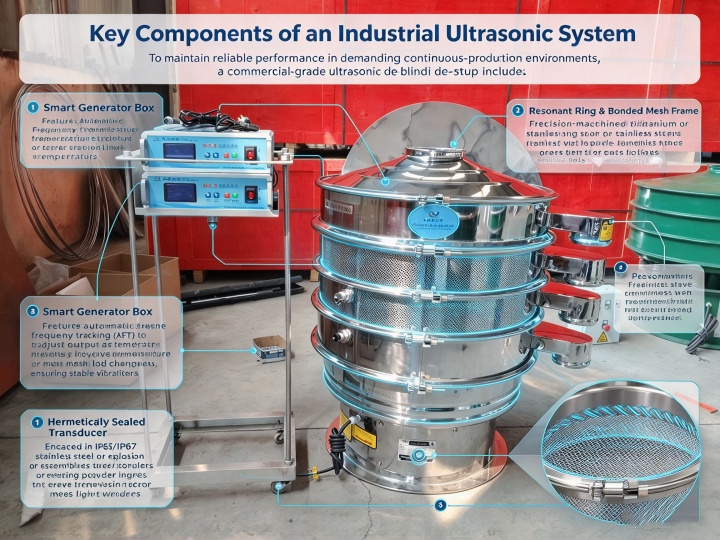
To maintain reliable performance in demanding continuous-production environments, a commercial-grade ultrasonic de-blinding setup includes:
Smart Generator Box: Features automatic frequency tracking (AFT) to adjust output as temperature or mesh load changes, ensuring stable vibration output.
Hermetically Sealed Transducer: Encased in IP65/IP67 stainless steel or explosion-proof housings, preventing powder ingress or gas leaks when handling reactive metal powders.
Resonant Ring & Bonded Mesh Frame: Precision-machined titanium or stainless steel ring assemblies that ensure linear wave transmission across light wire meshes without causing fatigue cracks.
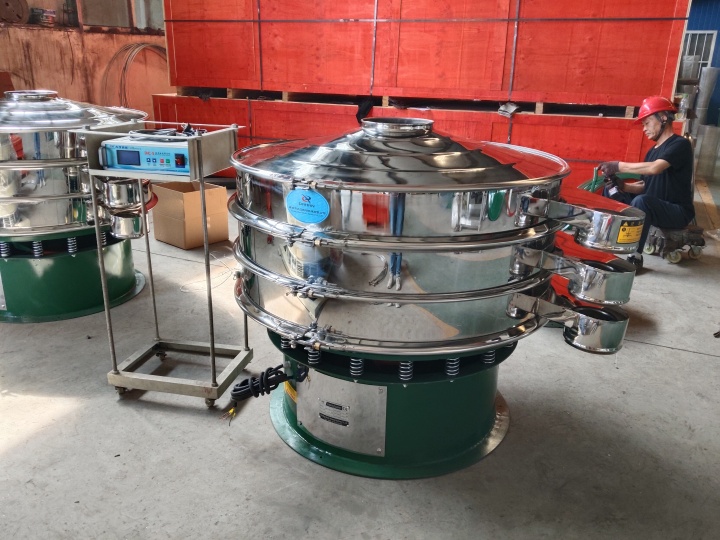
Ultrasonic de-blinding technology is critical in high-value, high-purity powder processing industries:
Additive Manufacturing (3D Printing): Reclaiming unused titanium (Ti6Al4V), aluminum (AlSi10Mg), and nickel superalloy powders (15−53μm) without oxygen exposure or spatter contamination.
Energy Materials: Precision classification of lithium iron phosphate (LFP), synthetic graphite, and cathode precursors for lithium-ion battery manufacturing.
Advanced Ceramics & Metallurgy: Sifting tungsten carbide, silicon nitride, and carbonyl iron powders where tight particle size distribution (PSD) is strictly enforced.
Pharmaceuticals & Fine Chemicals: High-purity screening of Active Pharmaceutical Ingredients (APIs) and fine excipients requiring zero cross-contamination.
No. Ultrasonic systems operate at a extremely low amplitude (measured in micrometers), unlike heavy mechanical impacts from bounce balls. By reducing particle friction and preventing wedging force, ultrasonic energy actually extends screen mesh service life.
Yes. Ultrasonic resonant rings can be custom-fitted onto standard round vibrating separators, tumbler screeners, and rectangular sifters from most major equipment manufacturers.
Yes. Specialized transducers with ATEX / IECEx certified explosion-proof ratings are specifically designed for inert gas closed-loop systems and hazardous powder screening.
Looking to integrate ultrasonic screening into your production line?
Learn how our ultrasonic technology is fully integrated into the Metal Powder Rotary Sieve Machine to maximize throughput and achieve reliable closed-loop powder recycling.
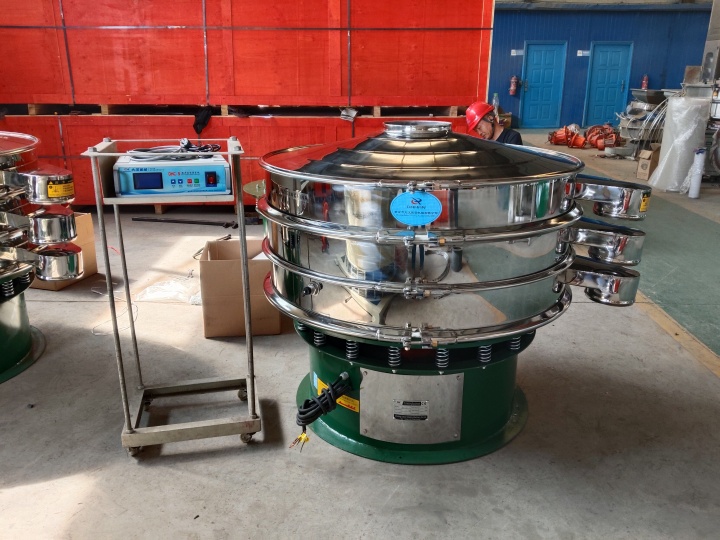
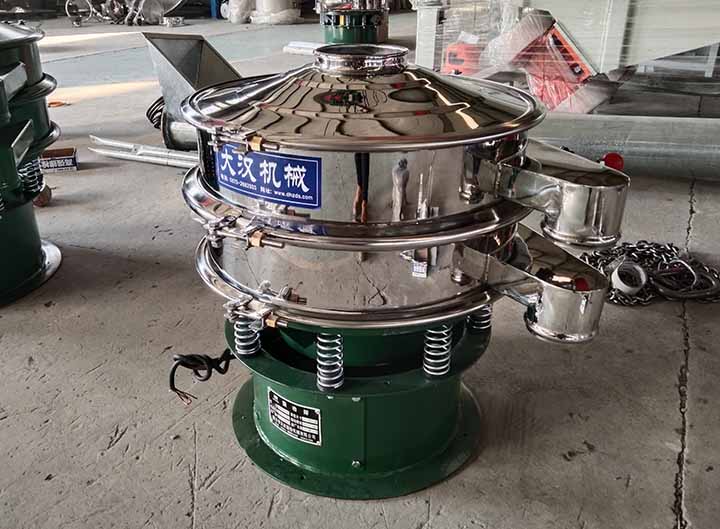
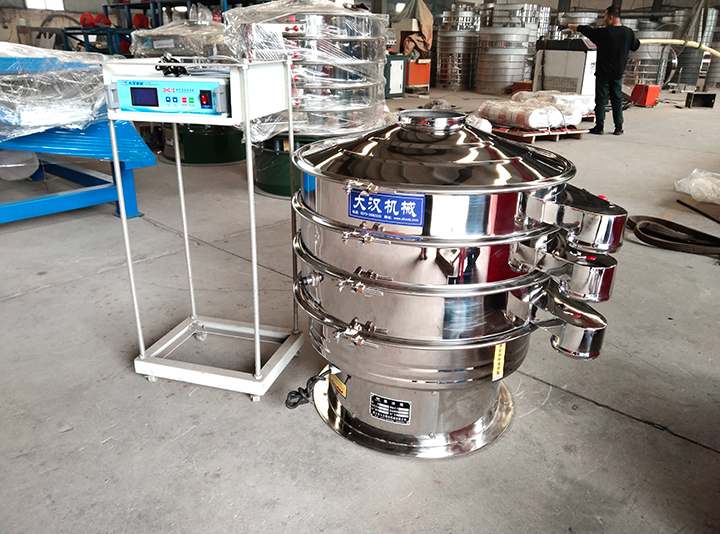
SIEVING MACHINE | INDUSTRIAL VIBRATORY SCREEN SEPARATOR | GRADING EQUIPMENTS SUPPLIER - DAHAN MACHINERY
HEED HELP?
Our professional assistants are trying to help you.